Extended-State DMT (DMTx)
Ashta's extended-state retreat research builds on a specific body of public work. Carl Hayden Smith is the person who has spent more documented time inside the extended DMT state than almost anyone alive — and who thinks hardest about the conditions that shape it.
Our Stance
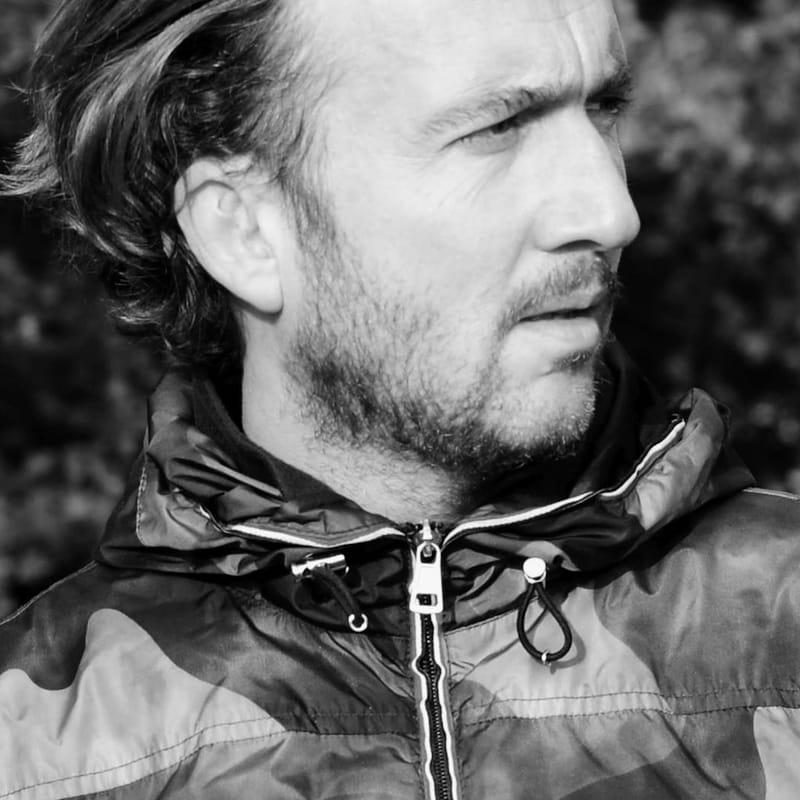
We present Carl Hayden Smith's public work here as a scientific and methodological reference. Please note: Carl Hayden Smith has no affiliation with, partnership with, or promotional agreement with the Ashta Project. We describe and link his published work purely as part of the lineage our retreat research builds on; any future named collaboration would be confirmed in writing, with his consent, before it appeared here.
The Work — "Subject Zero"
Carl Hayden Smith is an Associate Professor of Media at the University of East London. He is best known as the long-term human participant — often called "Subject Zero" or "Patient Zero" — in Imperial College London's extended-state DMT research, run through its Centre for Psychedelic Research. Over roughly six years he took part across three phases of the work: EEG, then EEG combined with fMRI, and finally the extended-state DMTx phase, in which a continuous, target-controlled intravenous infusion holds a stable concentration of N,N-DMT in the blood and stretches the usual ten-minute experience into a prolonged, navigable state. Smith was the first person to sustain the full five doses of the DMTx pilot.
To be precise about his role: he was a research participant and phenomenological reporter, not an author of the neuroimaging papers (which were led by Dr Chris Timmermann). What he contributed is something rarer than a citation — a first-person map of how the extended state stabilises, including the reported phenomenology so often discussed in this research (the visual, spatial and entity-contact reports), described from the inside, repeatedly, under controlled conditions. The pilot's published purpose was to establish the safety, feasibility and tolerability of holding a person in a prolonged DMT state — not to make any therapeutic claim, and nor do we.
His Own Research
Beyond the DMTx studies, Smith is a prolific academic — he has delivered over 300 invited lectures across 40 countries, published 50+ academic papers, and raised more than £10 million in research funding (Horizon Europe, FP7, Erasmus+, XPRIZE). But his distinctive contribution is about the environment a state happens in. He is the founder of the Museum of Consciousness (interactive, audio-led exhibits that shift awareness through sound and setting rather than substances), co-founder of the Cyberdelics Nexus (using immersive media and biosensors to study and support altered states), and a director at Noonautics. Two ideas run through all of it:
His functional-sound work — using designed audio to steer, anchor and later reactivate a state without the chemical — bears directly on integration: the part of any retreat where a powerful experience either becomes durable change or fades.
Why it matters to Ashta's retreats
Ashta's whole thesis is that you measure the experience and the conditions that produced it, then track whether anything durable changed. Smith's Context Engineering gives a rigorous language for the conditions; his first-person map of the extended state helps facilitators read where a participant is; and his functional-sound tools give an integration method we can actually measure against. He is, in short, the kind of bridge between subjective depth and honest method that a de-wooed retreat programme is built on. A model for a legal, physician-supervised DMTx retreat already exists — the Eleusis programme (Bequia, St Vincent & the Grenadines), where Smith is Director of Context Engineering, working alongside the researchers who developed the DMTx protocol.
Watch — in his own words
His TEDxOxford talk on the re-enchantment of life, and his Breaking Convention lecture on extended-state DMT and the technologies of altered states:
"An Ecology for the Re-Enchantment of Life" — Carl Hayden Smith, TEDxOxford (TEDx Talks, 2021). ID: a2KZm4cMg1E
"DMTx to Interbeing Technologies: Modifying the Phenomenology of Altered States" — Carl H Smith, Breaking Convention (2023). ID: 84FcX5qshf4
Resources & Links
What we'd never claim
We won't tell you DMTx is proven to heal, that the extended state's reported encounters are literally real, or that a retreat will change your life. Extended-state DMT is an emerging research area; strong therapeutic claims would be premature, and we make none. We measure outcomes, publish nulls, and make no medical, diagnostic, or treatment claims. See how we'd measure a retreat or the wider research lineage.