Contested-Science Lineage
For four decades Thomas Joseph Brown has been one of the most careful custodians of a body of claims mainstream science rejected — which is exactly why a project built to test those claims values what he knows.
Why he's here
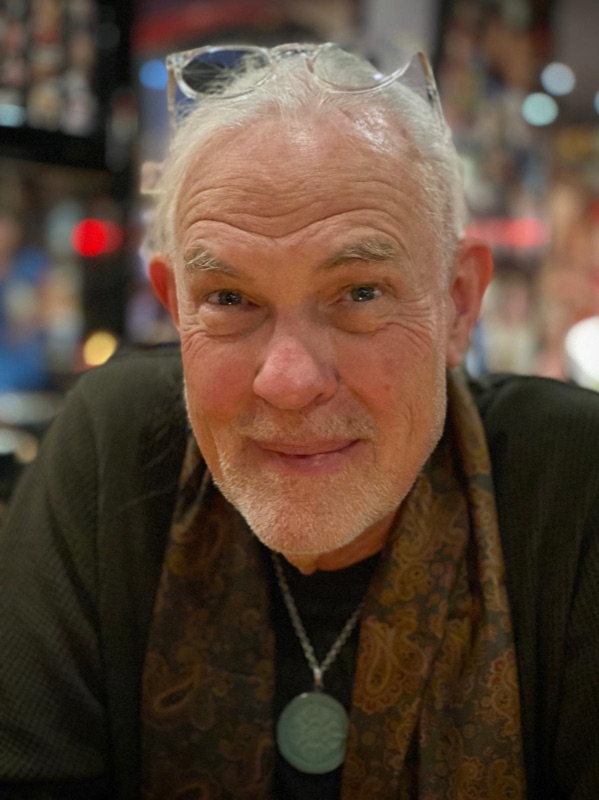
Ashta is a collective of people who want one thing: the honest truth, whatever it turns out to be. A collective like that needs more than hard sceptics — it needs rigorous explorers of the contested too, because each holds information the other doesn't, and both welcome being proven wrong. Thomas Joseph Brown is the explorer. He has spent four decades examining the claims orthodox science set aside — not as a believer, but with an empiricist's discipline: source it, observe it carefully, and hold it as a question rather than a creed. That is the same instinct that has a researcher like Rupert Sheldrake test a claim under controlled conditions instead of merely asserting it. To be clear: Ashta does not claim the traditions Thomas has studied are true — most sit outside, and are rejected by, mainstream science, and we say so plainly below. What we value in Thomas is that he knows that terrain better than almost anyone alive, holds it with a sceptic's discipline, and wants the truth about it as badly as we do.
The Work — editor of a fringe-science archive
Thomas Joseph Brown was Director and President of the Borderland Sciences Research Foundation (BSRF) from 1985 to 1995 — a research and publishing body founded in 1945 as a clearinghouse for the phenomena orthodox science would not touch. As Editor-in-Chief he edited fifty issues of the Journal of Borderland Research, archiving and re-publishing primary material on Tesla's work, Viktor Schauberger, Georges Lakhovsky's Multiple Wave Oscillator, radionics, and the etheric-physics tradition. He worked directly with the aviation historian and etheric-weather researcher Trevor James Constable, editing the revised Cosmic Pulse of Life and producing Loom of the Future, the documentary record of Constable's work.
What that makes him is rare: not a believer shouting, but a meticulous editor and archivist who has spent a working life organising, sourcing and preserving a contested literature. That editorial rigour — applied to material most scientists dismiss — is the unusual thing he brings.
Where the mainstream stands — and we say so plainly
Honesty is the whole point of Ashta, so we are explicit about where his subject matter sits with mainstream science:
None of that makes the questions uninteresting. It makes them untested to modern standards — which is the gap Ashta exists to close, one pre-registered, blinded study at a time.
His current research
Today Thomas writes and teaches through the Chronicles of Alkemix, focusing on the geometry and structure of water and on the Goethean tradition of science — a participatory, observation-first method that values careful qualitative seeing alongside measurement. Ashta treats the Goethean approach as a perceptual discipline worth taking seriously, and the structured-water claims as exactly the kind of hypothesis its instruments could one day test — while holding both, openly, as unproven.
Why it matters to Ashta
Ashta's mission is to put the contested claims of the self-development and consciousness world under honest, instrumented test. Thomas Joseph Brown is, in effect, a living index of that contested terrain — four decades of knowing exactly what was claimed, by whom, and on what basis. An advisor who knows the territory cold, and who has an editor's instinct for sourcing, is precisely useful to a programme whose job is to separate what survives a blinded test from what does not. A lifelong explorer of these questions adds as much to the panel as a lifelong sceptic does: they have walked different ground and carry information the other lacks. His role sits alongside the credible-but-contested work we already build on — see the research lineage.
It comes back to the one question underneath everything Ashta does: what does the data say when it is raw and unmassaged — what does the information actually say — and can we honestly correlate meaning to it? Answering that needs the full spectrum of honest minds, the sceptic and the explorer alike, bound by nothing except wanting the truth more than wanting to be right.
Resources & Links
What we'd never claim
We won't tell you the ether is real, that radionics works, that "free energy" has been demonstrated, or that water carries the geometry of the cosmos. Mainstream science rejects those claims, and we say so. What we will do is take the honest version of any such question and, where it can be turned into a blinded, pre-registered test, test it — and publish the result, almost always a null. See what we measure or the research lineage.